Tuesday, November 30, 2010

It’s time for (beer):30!


Design|Spring, is starting a new tradition: a semi-annual social gathering for up-and-coming design, engineering, and construction professionals. The group’s hope is to open up lines of communication, foster networking, and simply help emerging professionals know one another better. Even if you don’t care for beer, they still hope to see you!
  • Date/Time: Thursday, December 2 at 5:30 PM
  • Location: The Bridge – 444 E. 3rd Street – right next to the Ferry Street Bridge (the former Peabody’s)

Design|Spring is a group of peers dedicated to fostering continued professional development amongst its membership. It serves as a bridge between the completion of professional education and full membership and participation with the various design and construction-related organizations (such as AIA, ASLA, ASID, and CSI). The group also functions as an interdisciplinary forum for the exchange of ideas and experiences among all emerging design professionals in Eugene.

Design|Spring’s first meeting of 2011 will occur on January 12. Look for more information to come. And stay in touch by connecting with Design|Spring on Facebook.

Sunday, November 28, 2010

Influences: William Kleinsasser

An earlier blog entry of mine, “Genealogy of Influence,” promised a series of posts about the architects and theorists who influenced my architectural world view. This is the fourth post in the series.

William “Bill” Kleinsasser was the professor who most lastingly shaped my beliefs about architecture during my studies at the University of Oregon in the early 1980s.(1) He was a complex man, deeply committed to that which he believed in, and joyous in his teaching. At the same time, he was dismayed by what he regarded as the willful conceptualizing and pretense of much of the architecture that he saw receive critical acclaim. He disagreed vehemently with his colleagues in the Department of Architecture if their beliefs jeopardized the wholeness of the curricula he championed. He was an advocate for architecture that is truly meaningful and evocative.

Throughout his decades-long tenure at Oregon, Bill taught students to understand the essential concerns of architecture; not just to design competent and clever buildings, which may be ingenious or stylish, but richly appropriate surroundings for people that measure up to the best we can imagine and hope for. Architects, he argued, should focus upon making beautiful places that invite people to be beautiful. He emphasized making places that are so clear, so rich, and so right that they genuinely symbolize our most strongly felt concerns about architecture. He urged us to work long and hard to develop ideas to levels that were extraordinary.

A focus of Bill’s teaching, and a touchstone for his vision of designing places for people, was experiencing architecture through the actions of ordinary living. His class Experiential Considerations in Architecture was a revelation for me. Bill spoke of how good places – large or small, public or private, inside or outside – provide settings that are precise, generous, lucid, liberating, and alive. The course’s theory base remains today the foundation of a required class in the UO Department of Architecture.

Bill’s career in architecture followed military service in Korea and graduate studies at Princeton University, where he would cross paths with Charles Moore, Donlyn Lyndon, William Turnbull, and Hugh Hardy. Influential there as a visiting lecturer was Louis Kahn, for whom he would later work briefly. Bill and his wife Ann also spent time in Switzerland where he worked for a firm. They eventually returned stateside and Bill began teaching at Oregon.(2)

Bill’s approach to teaching was personal, reflective, and constantly evolving. A case in point was his writing: his textbook Synthesis was self-published and available for purchase by students at the UO bookstore. He updated Synthesis many times; I believe its final iteration was the ninth edition. With each revision, Bill revealed an ever more comprehensive theory base for architecture. And yet he was never satisfied: Synthesis could always be better, more deliberately concise, more focused. It should come as no surprise that Bill often quoted from The Elements of Style, William Strunk Jr. and E.B. White’s seminal little book on written composition. Brevity is a virtue that Bill admired. The Elements of Style conveyed many lessons that he found applicable to the making of memorable places, such as how the vague and general could be transformed into the vivid and particular, or how the approach to style is by way of plainness, simplicity, orderliness, and sincerity.

With Synthesis, Bill outlined a methodology that by the book’s fifth edition grew to include eight objectives that can be studied and developed, responded to in our projects, returned to again and again as a theory base, and changed when necessary. The objectives are:
  • To support purposes and activities
  • To establish longevity
  • To respond to place
  • To maintain historical continuity
  • To integrate construction
  • To integrate services and environmental control
  • To achieve clarity
  • To establish vitality
Additionally, Bill divided the act of design-synthesis into two parts:
  • Determining an appropriate organizational structure; that is, to determine a basic theme or direction that appropriately orders all parts. If this structure is to be comprehensive, it must be based upon all of the objectives.
  • Developing the structure; that is, to actually establish the opportunities and qualities called for by the project.
Bill believed it is essential to realize that appropriate organizational structure cannot be determined by acts of personal expression alone. As a synthesis of many factors, it becomes clear slowly and after great effort on the part of the designer. Emerging first as a feeling, it must be tested and developed. Once determined as the correct organizing principle, it may be followed and reinforced. If used well, it will lead to an appropriate, unified, and eloquent real place.

Another focus of Bill’s career in academia was his study of the idiosyncratic work of Henry Chapman Mercer. During my studies under Bill, I considered Fonthill, the Mercer Museum, and Mercer’s Tileworks to be ugly and unworthy of his extensive attention. Since that time, I have come to understand what Bill appreciated about these curious buildings. He recognized Mercer’s deep, instinctive understanding of and feeling for the place in which the structures are located. The qualities of the cast-in-place concrete buildings seemed just right in the haunting serenity and mystery of the Bucks County, PA countryside. They reinforce, dramatize, and celebrate their joined physical context. Bill’s book on Henry Mercer, A Splendid Torch, is in final preparation for publication. I hope to obtain a copy as soon as it is available.

Fonthill, by Henry Chapman Mercer (photo by KForce from Wikipedia)

Bill passed away this past September 22 at the age of eighty-one after a battle with esophageal cancer. I was unaware that he had died; I only found out after reading the most recent issue of the School of Architecture and Allied Arts Review. I regret not visiting with him before his illness took him from us. I had sought out his guidance upon my return to Eugene in 1988, but had spoken with him rarely since then. He truly was a great teacher. I will forever be indebted to Bill Kleinsasser for opening my eyes to architecture’s potential to help us understand what we are a part of, where we have been, where we might go, and who and what we are.

(1) In addition to Experiential Considerations in Architecture, I enrolled in two design studios with Bill: one during my third year in architecture, and then my terminal project studio in the B.Arch program.

(2) Bill was an outstanding high school and college football player. He went to Princeton on an academic scholarship but received All-America mention while playing football on a Princeton Tigers team ranked in the nation’s top 10.

Sunday, November 21, 2010

November AIA-SWO Chapter Meeting Recap

Don Stastny, FAIA

While technically not the last chapter event on the 2010 AIA-Southwestern Oregon calendar (that being our annual holiday party on December 15), the November AIA-SWO meeting served as a fitting culmination of the year’s focus on design excellence. Throughout his tenure as 2010 chapter president, Michael Fifield promoted the role of good design in our built environment. The November meeting was no exception: Michael invited key advocates for the Design Excellence|Oregon initiative to describe that program’s potential to raise the bar for architecture throughout our state.

Design excellence in the built environment benefits every Oregonian. We value our quality of life, plan for orderly development of land at the interface of rural and urban areas, and enact laws to protect our natural environment. Underlying Design Excellence|Oregon is the belief that design excellence is a basic right for all of us who are fortunate to live here.

Of course, these are statements of principles and values with which few would disagree. What are the specific plans for realizing the goals of the initiative?

AIA Oregon and The Center for Architecture (CFA) in Portland propose Design Excellence|Oregon as a methodology for ensuring that the best design talent possible is matched with client groups and their projects. Although it’s easiest to picture its widespread application at all levels of public sector design services procurement, the persons behind the program also believe it may find acceptance among private clients.

The principal author of Design Excellence|Oregon is Don Stastny, FAIA. Don is recognized as one of the nation’s preeminent design competition advisors. In 1980, he directed the seminal competition for Portland's Pioneer Courthouse Square, creating a process that would be published in the AIA Guidebook for Architectural Competitions. He later wrote the Government Services Administration’s Design Excellence Guide—Creating a Legacy, and contributed significantly to development of the federal Design Excellence Program (of which the Wayne L. Morse Federal Courthouse here in Eugene is a shining example). He has advanced design competition processes such that they protect the participants from exploitation and create opportunities for emerging talent.

Pioneer Courthouse Square, Portland (photo from http://www.pioneercourthousesquare.org/)

Don presented our audience with an outline for the Design Excellence|Oregon program. On hand to assist Don were:
  • Stan Chessir, AIA – President, AIA Oregon
  • Chris Eberle, AIA – VP of Legislative Affairs, AIA Oregon
  • Steve Thomson, AIA – Co-chair, Oregon Design Conference
The goals of the Design Excellence|Oregon Initiative include:
  • Creating a statewide culture of design excellence in which citizens equate the quality of the built environment with quality of life and require the standard of environmental design in their communities to be commensurate with the extraordinary qualities of Oregon’s natural environment.
  • Creating a statewide program to enable design excellence that engages public and private resources in all Oregon communities and is accessible to the State, municipalities, counties, agencies, and the private sector.
  • Establishing a statewide model of a design excellence program that can respond to, and reflect, the unique cultures of communities throughout America.
The program suggests two different selection process formats, one involving two stages and the other three. The two-stage process would involve portfolio evaluations and A/E team interviews. The three-stage process adds a juried design vision competition (selected participants would be compensated). Both formats would be structured to result in the selection of the design firm and its lead designer, not the design.

The success of Design Excellence|Oregon is predicated upon a commitment to these processes and the consistent application of a high level of professionalism to ensure fairness and integrity. The draft program guidebook outlines the various steps that participating sponsors would be obliged to follow. These include appointment of an A/E Evaluation Board, and (in the instance of a three-stage process) hiring of a Professional Competition Advisor and selection of an independent jury of private-sector design professionals.

The Center for Architecture would furnish assistance to program sponsors by selecting and training Private-Sector Peers. During the procurement process, the Peers would confer with and advise the sponsor regarding proper execution of the Design Excellence|Oregon process. As highly respected professionals, the Peers’ advice and insights would be invaluable to those responsible for administering and designing the project. The CFA would provide a modest honorarium plus travel and per diem expenses to the Peers for each project.

Ultimately, Design Excellence|Oregon is about ensuring that the best and brightest of our profession are given equal opportunity to contribute to the excellence of Oregon’s built environment. It’s too often been the case that firms with the most substantial marketing resources and largest portfolios end up as the recipients of the significant design commissions, rather than those with the best approach to solving a given problem. The Design Excellence|Oregon process is intended to “level the playing field” by placing greater emphasis upon such factors as design philosophy, understanding of design issues associated with the proposed project, and commitment of the lead designer.

Some have their reservations about Design Excellence|Oregon. Several questions arose during the course of the 2010 AIA Northwest & Pacific Region Conference, hosted by AIA-SWO here in Eugene last month. What would prevent Design Excellence|Oregon from becoming hostage to a cabal of self-appointed tastemakers? Won’t the program burden sponsors with layers of bureaucracy on top of the already onerous challenges that confront building projects? Isn’t design excellence expensive?

Don had ready answers to these questions and more. Design Excellence|Oregon isn’t about iconic architecture. It’s about the quality of life Oregonians can look forward to in the future. Design Excellence|Oregon will be community-centric. One size will not fit all. What works for Portland will not necessarily be applicable in Medford, or La Grande, or Eugene. The program will not be totally driven by metrics; there will be allowances for the un-measurable, for ingenuity, and for true creativity. Yes, there may be added expenses, but thoughtless design is exponentially more costly.

Chris Eberle pointed out that most of us tend to be legislatively reactive. Design Excellence|Oregon presents the architectural community with a chance to be proactive. All AIA Oregon members can advocate on behalf of the program when it is rolled out, encouraging its adoption at the state, county, and municipal levels, as well as by other institutional client groups and associations. All Oregonians will benefit if Design Excellence|Oregon is as widely implemented as it should be.

Don has already assembled an impressive roster of champions, alliances, and resources in support of Design Excellence|Oregon. The list includes the Architecture Foundation of Oregon, Oregon National Guard, Housing Authority of Portland, Energy Trust of Oregon, ASLA Oregon, APA Oregon, Metro, Tri-Met, Solar Energy Industries Association of Oregon, Portland State University, and the University of Oregon.

AIA Oregon and The Center for Architecture also have a focused set of activities planned for 2011 that are intended to promote the culture of design excellence. One goal is to capitalize upon the 100th anniversary of the chartering of AIA-Oregon, by introducing the definitive “toolkit” for Design Excellence|Oregon. Other proposed initiatives for 2011 include establishing the Private Sector Peer Program, engaging the Mayors’ Institutes on City Design, introducing design excellence curricula at Portland State University and the University of Oregon, and assembling an oral history of 100 years of Oregon architecture for the library at The Center for Architecture.

It’s Don’s opinion that only in Oregon could we introduce a program like this. What makes Oregon unique is the passion its residents have for their home state. The outdoors is an integral part of most Oregonian's lives. We have a deserved reputation for being on the vanguard of sustainable design. Our predominantly progressive political leanings offer less resistance to the introduction of paradigm-shifting initiatives (an example being the 1971 Oregon Bottle Bill, the first such container legislation passed in the United States).

It’s also a truism that no one in the country is better suited to produce an initiative like Design Excellence|Oregon than Don Stastny.

The Oregon Design Conference’s esteemed maharishi Bob Hastings, FAIA, once said the following of Don:

“He’s an architect and urban designer who seeks out opportunities to bring all people into the design process. The mark of his greatness is when his students, clients, colleagues and stakeholders become active participants and leaders for design excellence.”

With Don at the helm, I know that Design Excellence|Oregon will be a success.

*  *  *  *  *  *

Paul Dustrud, AIA-SWO President-Elect, has chosen to devote his presidency in 2011 to further the discussion of design excellence. The momentum generated for design excellence within our chapter by the 2010 Oregon Design Conference and the 2010 AIA Northwest &Pacific Region Conference will thus continue through next year and no doubt for many years to come.
Enhanced by Zemanta

Monday, November 15, 2010

Talks, Tours, and Tables

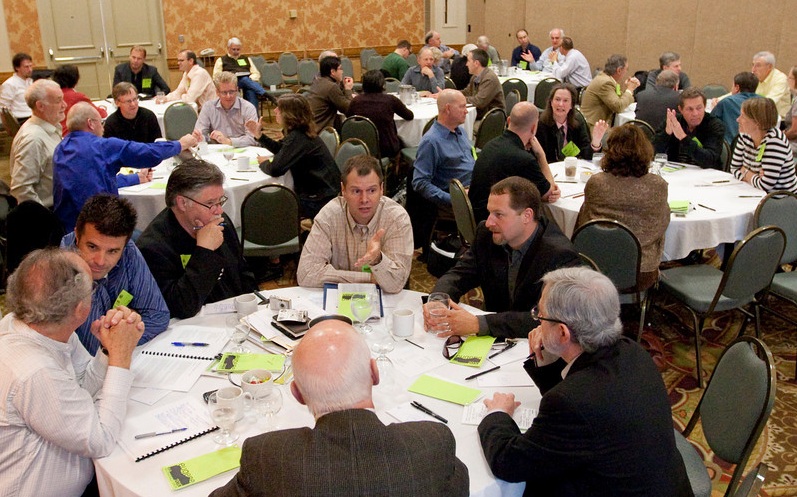
AIA members and associates engaged in spirited discussions during "round table" sessions at the 2010 AIA Northwest & Pacific Region Conference this past October in Eugene (photo by Erik Bishoff)

This will be my final post about last month’s 2010 AIA Northwest & Pacific Region Conference. This one spotlights the wonderful photography of Erik Bishoff, Associate AIA, and Janet Jansen Knoblach. The conference was hosted by AIA-Southwestern Oregon, October 13-16, 2010 in Eugene.

We dubbed the 2010 AIA Northwest & Pacific Region Conference “An Emerald Vision.” Why? Because we wanted to look forward, to a near future for architecture and society that is holistic and integrated, a time when being green is a given.

The conference examined the prospects for an architecture that is truly sustainable, amid the realities of climate change, dwindling resources, and the rapid transformation of current professional practice paradigms. Through three fundamental tenets – equity, economy, and environment – An Emerald Vision explored how design excellence, the future, and genius loci coalesce and inform contemporary architectural practice.

The 2010 Conference Trade Expo featured over 50 vendors displaying an impressive range of building products and services (photo by Erik Bishoff)

Donlyn Lyndon, FAIA, spoke about the importance of place-making (photo by Erik Bishoff)

Corvallis City Council member Dan Brown, Eugene Mayor Kitty Piercy, and HUD Senior Advisor for Sustainable Housing & Communities Shelley Poticha pondered Placemaking & Parochialism: The Conundrum of Mid-Sized Communities (photo by Erik Bishoff)

The Silva Concert Hall stage at the Hult Center for the Performing Arts was filled by a lunchtime audience for the Placemaking & Parochialism panel discussion (photo by Erik Bishoff)

The conference schedule almost always had a distinguished speaker giving a lecture (talks), an intriguing panel hosting a roundtable discussion (tables), or an excursion to explore a noteworthy example of architecture (tours).

UO faculty member Nico Larco, AIA defined urbanism as a social condition rather than as a geographic phenomenon (photo by Erik Bishoff)

Former GSA Chief Architect Ed Feiner, FAIA, recounted the history of the federal Design Excellence program (photo by Janet Jansen Knoblach)

The University of Oregon's new Matthew Knight Arena, one of several outstanding projects toured by attendees of  the 2010 AIA Northwest & Pacific Region Conference (photo by Erik Bishoff)

I participated as a panelist for the Design Excellence/Oregon 1: Defining Excellence session (photo by Erik Bishoff)

Audience members enjoy the discussion during the closing plenary session (photo by Janet Jansen Knoblach)

We viewed the power of good design from the vantage of the widest possible context. We considered transportation, civic leadership, land-use planning, even the effect of natural disasters on place-making. We heard from architects and deep thinkers. It was a design conference.

Enhanced by Zemanta

Reflections on an Emerald Vision

Don Kahle (photo by Erik Bishoff)

One more post about last month’s 2010 AIA Northwest & Pacific Region Conference. This one is guest-authored by AIA-Southwestern Oregon Executive Director Don Kahle, whose writing inspired my previous blog post entitled “Ambition.” An address to the AIA-SWO membership, Don’s “Reflections on an Emerald Vision” is a testament to the broad-ranging dialogue stirred by the 2010 Conference.

I am most grateful that I came away from our region conference with a few big ideas for myself. I’ve pondered them for the past few weeks and they have grown and fed one another since. I thought it might be useful to share.

Alan Durning started his talk with a series of “highly improbable” outcomes from seemingly small events. He identified one as the beginning of abolitionism, a hundred years before the end of slavery. Another marked the start of what became the women’s suffrage movement in America. He could have added the civil rights movement, which happened — miraculously — in our lifetimes.

He suggested that these movements began with the articulation of a moral imperative — a cause that was so self-evident that the chaos to the system reached an inevitable conclusion, that people should not be considered property, or that women deserve what men have. I read recently that America’s 1788 presidential election in America had only 39,000 voters — even though there were approximately 4 million people living in America at the time.

That got me thinking that maybe there’s only one moral imperative, only one self-evident truth that’s powerful enough to shape a society and maybe a world. How does the Declaration of Independence put it? “We hold these truths to be self-evident, that all men are created equal, that they are endowed by their Creator with certain unalienable rights ….” What if “equal rights” is the only moral imperative?

Can’t then stewardship of the planet and whatever is “beyond green” be understood as equal rights for future generations? Isn’t it really that simple? We’ve learned that people are equal, even if they aren’t land owners, even if they are of a different race or gender. Maybe the next step is for us to consider the rights of the unborn!

Alan Durning (photo by Erik Bishoff)

This is of course not new. The Great Law of the Iroquois is to consider the impact on the next seven generations, but it’s not an easy concept for Western minds. As Groucho Marx once quipped, “What have future generations ever done for us?” Exactly. If we can’t see it, it can’t be real.

Durning quoted Wendell Berry, challenging the idea that ours is a materialistic society. Far from it, the farmer-poet insists! If we were materialists, we would take care of things. We are symbolists, so the make-model-color of the car we drive speaks volumes about who we understand ourselves to be. That’s not materialism! It’s the opposite.

Tom Bowerman showed a graph during his talk about the Happiness Index. It turns out (building on the argument that we’re not materialistic in the truest sense) that wealth doesn’t make people happier. What does seem to correlate strongly to happiness is distribution of wealth. In nations where everybody has roughly the same wealth, happiness was higher. This was equally true in poor Latin American countries or rich Scandinavian countries.

This is an important discovery, because Bowerman’s research shows that consumption habits may be easier to change than conservation habits. It’s also heartening because people seem more willing to change than governments. When people are happier, they can be less susceptible to the lure that they will be happier if they consume more.

Tom Bowerman (photo by Erik Bishoff)

Bowerman and I have started exploring whether the same dynamic that shapes happiness might also turn up in “job satisfaction.” If people are satisfied at their work, could they be more easily persuaded to curb their consumption and become materialists in the literal (and Iroquois) sense?

Even more exciting, could employers have a direct impact on their employees’ lives and choices by dividing the salaries at the company more evenly? It’s very possible that a fair and transparent salary distribution would bring better results for the planet than all the recycled paper and car pooling a company can devise.

Wouldn’t it be exciting to see that the impacts are that direct for the planet and the unborn generations, and so completely within our control? Healthy work environments might be the best expression of what’s “beyond green.”

But when you look at it closely, you see that environmental threats are only one of the perils we face as a planet. Hunger and war for starters, but a hundred others as well. If we solve global warming, we’re gonna crash and burn a different way, and maybe just as soon.

That makes me believe now that we’re shaking the wrong end of the rattle. We know what’s going to be necessary to avert a climate disaster — collaboration, inclusiveness, equality, far-sightedness. These are all values that architects practice every day. But those values will also be necessary to solve the other quandaries we face as a species.

I now believe that your profession — your discipline — is what will bring us beyond green. That’s really exciting to me.

==

Don Kahle